Guide
Rolling or inward swing: which driveway gate fits your lot
Palmdale gives you two legal ways to gate a driveway: a gate that rolls sideways, or one that swings in toward the house. Neither is better everywhere. The right one depends on the room beside and behind your gate, the slope of the drive, and how much sand blows across it.
Checked against the sources below on September 22, 2026
What Palmdale allows
The zoning code says fencing across a driveway must be "an automated rolling gate, or open inward, away from the public right-of-way," and that any main gate opens away from the right of way. Two practical points follow. A rolling gate across the drive is expected to have an opener. And a swing gate can go manual or automatic, as long as its leaves open toward the house. A gate that swings out toward the street is off the table.
Rolls sideways
Allowed.
Swings in
Allowed.
Swings out
Not allowed.
The room each one needs
A rolling gate slides into space beside the opening. It needs a clear run along the inside of a wall or fence at least as long as the opening, and longer for a design with a braced tail. Trees, a utility meter, steps or a side yard gate in that strip will block it. Seen from above, the track runs past the opening along the wall, which is where the open gate parks.
An inward swing needs space behind the gate instead. Each leaf sweeps an arc as wide as the leaf itself, so a 12 ft opening split into two leaves needs about 6 ft of clear driveway behind each side. Parked cars, planters and a garage close to the gate all eat into that. A single wide leaf needs its whole width clear.
On lots of 20,000 sq ft or more, remember the vehicle gate has to sit at least 20 ft back from the property line, which moves both kinds of gate further up the drive.
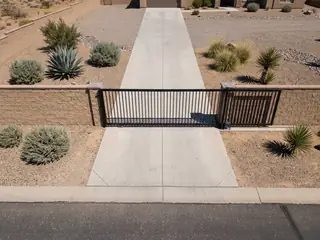
A rolling gate needs a clear run beside the drive
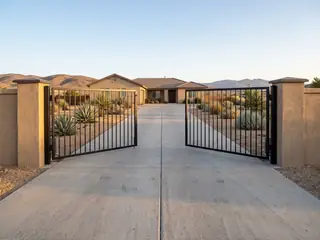
Inward leaves need room on the driveway
Slope, sand and the drive
A drive that climbs toward the house is the classic problem for an inward swing. The leaves swing uphill, and the bottom rail meets the rising ground before the gate is fully open. The fix is a leaf cut to follow the slope, hinges set to lift the leaf as it opens, or a rolling gate instead.
Rolling gates have their own weak spot. Soil survey maps show mostly sandy loams across Palmdale's valley floor, and a ground track collects that sand and gravel. It needs sweeping, and the wheels wear faster when it's neglected. A gate that hangs on rollers beside the drive, with no track on the ground, avoids that, though it needs even more side room for its tail.
Cost
National cost guides don't agree on which costs more. One lists installed automatic swing gates at $2,500 to $8,500 and slide gates at $1,800 to $7,650, calling sliding usually cheaper. Another puts automatic swing gates at $1,000 to $6,000 and sliding at $1,500 to $5,000. In Palmdale there's an extra factor: a manual inward swing needs no opener, while a rolling gate does. The gate cost page has the full ranges.
How to choose
- Measure the clear run beside the opening. At least the opening's length? A rolling gate works.
- Measure the clear, fairly level driveway behind the gate. At least one leaf's width? An inward swing works.
- Does the drive climb toward the house? Lean rolling.
- Want to skip the opener? Choose an inward swing.
- Lot of 20,000 sq ft or more? Mark the 20 ft line first.
- Still unsure? Send photos of the drive with the form, and the installer can say what fits.
Sources
Know which gate you want?
The driveway gates page covers each type in more detail, and our overview of installing a driveway gate in Palmdale explains how a match with an installer works.
See driveway gates